
Out Of Stock

Unpublished Letters and Selected Articles


₹ 225.00
DAVID J. McCUTCHION
Unpublished Letters and Selected Articles
Compiled and edited by Suhridkumar Bhowmick
This book is uniquely enriched with about 70 priceless letters written by David McCutchion over a decade to the editor of this book. Beside this the book contains some invaluable writings on the temples of Bengal, about comparative religion, two unpublished articles on the struggle of East Bengal of that period and also a lot of unpublished photographs taken by David.
Out of stock

Description
DAVID J. McCUTCHION
Unpublished Letters and Selected Articles
Compiled and edited by Suhridkumar Bhowmick
Bengalis should forever be indebted to this man from England. Due to his premature death he could not publish his entire works on the temples of Bengal along with some selfless research-workers, traveling to the most treacherous remote corners of Bengal. He also had a keen interest in ‘Pat’ of Bengal. Once his student, Sri Suhrid Bhowmik became his travel and research associate in the later part. David wrote a number of letters to Bhowmik, and this book is uniquely enriched with about 70 priceless letters written by David over a decade to him. Beside this the book contains some invaluable writings on the temples of Bengal, about comparative religion, two unpublished articles on the struggle of East Bengal of that period and also a lot of unpublished photographs taken by David. A book to be worth collected.
176 pages + 16 pages of art plates
Additional information
| Version | ebook, hardcopy |
|---|
You must be logged in to post a review.
Related products
-

Nemai Ghosh
Talking about Films
Writings Speeches InterviewsThis is a collection of English writings, speeches and interviews of Nemai Ghosh, best known as the director of the first neo-realist film ‘Chinnamul’ that dealt with partition of Bengal during the partition of India in 1947.
₹ 50.00Talking about Films_e-version
Nemai Ghosh
Talking about Films
Writings Speeches InterviewsThis is a collection of English writings, speeches and interviews of Nemai Ghosh, best known as the director of the first neo-realist film ‘Chinnamul’ that dealt with partition of Bengal during the partition of India in 1947.
₹ 50.00 -

This is the celebrated book on art and aesthetics of the east written by the Japanese master artist, theoretician and art activist Kakuzo Okakura.
₹ 40.00The Book of Tea_e-version
This is the celebrated book on art and aesthetics of the east written by the Japanese master artist, theoretician and art activist Kakuzo Okakura.
₹ 40.00 -

Bharat Mansata
Organic RevolutionThis remarkable story demolishes the myth that organic farming can never feed the world! Holistically adopted, it can also revitalise society, enhance the environment and safeguard future generations. In the current raging debate over urban-industrial uprootment of farmers, here is one example the world cannot ignore. After the Soviet Union collapsed – and the US tightened its embargo – Cuba’s Organic Revolution began suddenly, under compulsion. A decade later, in 1999, the Swedish Parliament presented the Right Livelihood Award, or ‘Alternative Nobel Prize’, to the Cuban Organic Farming Association – for “showing that organic agriculture is a key to both food security and environmental sustainability.” Today, not only has Cuba’s productivity increased, its economy, health, education, energy efficiency, water security, … are all big gainers. In 2006, the World Wide Fund for Nature (WWF) and the Global Footprint Network declared: Cuba is the only country on earth to achieve sustainable development! The American Journal of Public Health reported a 45% decline in cardiovascular diseases. Cuba’s bio-diverse agro-ecology and forest cover exceeding 25% also counter global warming. “Increasingly, people came to believe that productive, healthy harvests could be obtained on positive cost-benefit terms, while protecting the environment, … without excessive energy use.” – Dr. Fernando F. Aguilar, President, GAO, Organic Farming Association of Cuba “Cuba offers the very first large-scale test of sustainable alternatives, … before environmental realities mandate the rest of the world embark on a sudden, wholesale switch to organic agriculture.” – Dr. P. Rosset, Director, ‘Food First’, Institute for Food & Development Policy, Washington, USA “… Cuba is creating something truly new and hopeful for all of humanity.” -Prof. R. Levins, Harvard University School of Public Health.
Page 131, New edition
₹ 200.00Organic Revolution
Bharat Mansata
Organic RevolutionThis remarkable story demolishes the myth that organic farming can never feed the world! Holistically adopted, it can also revitalise society, enhance the environment and safeguard future generations. In the current raging debate over urban-industrial uprootment of farmers, here is one example the world cannot ignore. After the Soviet Union collapsed – and the US tightened its embargo – Cuba’s Organic Revolution began suddenly, under compulsion. A decade later, in 1999, the Swedish Parliament presented the Right Livelihood Award, or ‘Alternative Nobel Prize’, to the Cuban Organic Farming Association – for “showing that organic agriculture is a key to both food security and environmental sustainability.” Today, not only has Cuba’s productivity increased, its economy, health, education, energy efficiency, water security, … are all big gainers. In 2006, the World Wide Fund for Nature (WWF) and the Global Footprint Network declared: Cuba is the only country on earth to achieve sustainable development! The American Journal of Public Health reported a 45% decline in cardiovascular diseases. Cuba’s bio-diverse agro-ecology and forest cover exceeding 25% also counter global warming. “Increasingly, people came to believe that productive, healthy harvests could be obtained on positive cost-benefit terms, while protecting the environment, … without excessive energy use.” – Dr. Fernando F. Aguilar, President, GAO, Organic Farming Association of Cuba “Cuba offers the very first large-scale test of sustainable alternatives, … before environmental realities mandate the rest of the world embark on a sudden, wholesale switch to organic agriculture.” – Dr. P. Rosset, Director, ‘Food First’, Institute for Food & Development Policy, Washington, USA “… Cuba is creating something truly new and hopeful for all of humanity.” -Prof. R. Levins, Harvard University School of Public Health.
Page 131, New edition
₹ 200.00 -

PAUL GAUGUIN
Noa Noa: The Tahiti JournalOne of the most prominent post-impressionist artists, Paul Gauguin left his family and country only to move to the country of the so-called ‘uncivilized’ Maoris for the sake of painting. There he stayed with the Maoris, noted every intrinsic details of their livelihood and collected their mythology and folklores. He detailed every aspects of them in this book, elaborated the picture of a great civilization. Added with these are reproductions of many of his paintings drawn during his Tahiti days.
₹ 50.00Noa Noa: The Tahiti Journal_e-edition
PAUL GAUGUIN
Noa Noa: The Tahiti JournalOne of the most prominent post-impressionist artists, Paul Gauguin left his family and country only to move to the country of the so-called ‘uncivilized’ Maoris for the sake of painting. There he stayed with the Maoris, noted every intrinsic details of their livelihood and collected their mythology and folklores. He detailed every aspects of them in this book, elaborated the picture of a great civilization. Added with these are reproductions of many of his paintings drawn during his Tahiti days.
₹ 50.00 -
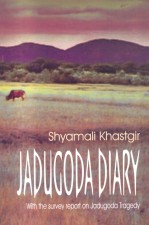
Shyamali khastgir
Jadugoda DiaryThe uranium that fuels India’s nuclear weapons and energy programme is mined at Jadugoda in Singhbhum district in the state of Jharkhand. The company that does the mining is Uranium Corporation of India Ltd (UCIL). UCIL was established in 1967 and started its operations in 1968 at Jadugoda with uranium ore mining and a processing plant, each of 1,000 metric tonnes per day capacity.
For more than three decades, there have been a large number of news reports in various magazines and newspapers, detailing various health problems suffered by the people of the area. Mostly these have concerned a large number of deformities in children and various kinds of lung problems.
Shyamali Khastgir surveyed the area in year 2000 and brought out this report.
₹ 40.00Jadugoda Diary_e-version
Shyamali khastgir
Jadugoda DiaryThe uranium that fuels India’s nuclear weapons and energy programme is mined at Jadugoda in Singhbhum district in the state of Jharkhand. The company that does the mining is Uranium Corporation of India Ltd (UCIL). UCIL was established in 1967 and started its operations in 1968 at Jadugoda with uranium ore mining and a processing plant, each of 1,000 metric tonnes per day capacity.
For more than three decades, there have been a large number of news reports in various magazines and newspapers, detailing various health problems suffered by the people of the area. Mostly these have concerned a large number of deformities in children and various kinds of lung problems.
Shyamali Khastgir surveyed the area in year 2000 and brought out this report.
₹ 40.00 -

BHOLANATH BHATTACHARYA
Esoteric Cults of Consort Worship in BengalFrom the very days of inception woman breeds a sense of fear as well as devotion in the minds of man due to her mysterious relation with the process of creation. Worshipping woman as a symbol of power of creation and fertility also started from then. At the preliminary stage woman was worshipped as mother. Later, as man also found himself as a contributor in this process of creation, woman started herself being worshipped as companion. The author gives a description of these confined cults which are practised in different parts of Bengal in India for a long time.
₹ 90.00Version : ebook - hardcopyEsoteric Cults of Consort Worship in Bengal
BHOLANATH BHATTACHARYA
Esoteric Cults of Consort Worship in BengalFrom the very days of inception woman breeds a sense of fear as well as devotion in the minds of man due to her mysterious relation with the process of creation. Worshipping woman as a symbol of power of creation and fertility also started from then. At the preliminary stage woman was worshipped as mother. Later, as man also found himself as a contributor in this process of creation, woman started herself being worshipped as companion. The author gives a description of these confined cults which are practised in different parts of Bengal in India for a long time.
₹ 90.00
Reviews
There are no reviews yet.